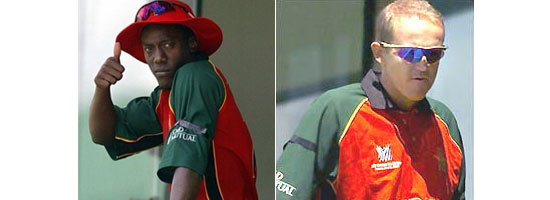
The world on Thursday commemorated former Zimbabwe cricket captain Andrew Flower and the first black cricketer to play for Zimbabwe, Henry Olonga’s Black armband protest against the death of democracy in Zimbabwe. On the 10th of February 2003, when Zimbabwe, co-hosting the cricket world cup with South Africa and Kenya were preparing for their match with Namibia on an overcast day at Harare Sports Club, two of their influential players, wicket-keeper Andy Flower and fast bowler Olonga took to the field wearing black armbands in a show of no confidence against Mugabe’s ZANU-PF regime.
At the time, Zimbabwe was going through a bad patch both economically and politically, a patch that would last for the entire first decade of the new millennium. Mugabe’s ZANU-PF, led by weapon-totting war veterans were terrorizing white farmers, or the few that were left, invading all the white owned farms across the country. The chaotic and highly racist land-redistribution program, meant to address the injustices of the past when the British settlers took over the land belonging to the indigenous people, was highly condemned and deemed unconstitutional by the courts. The land reform triggered an economic melt-down for the once prosperous bread basket of the region. The program in itself was a gross violation of human rights and to this day, the perpetrators of that dark period are still to be brought to book.
White farmers were given ultimatums to leave their properties within days. Some did not even get the chance to pack before the ZANU-PF youths invaded their land, burning some alive, some shot in front of their children and wives whilst some who resisted were arrested and tortured in the police cells. Property rights of these farmers were violated and these invasions were only targeted against white farmers, making the whole program wholly racist. White farmers were accused of supporting the new opposition party, the Movement for Democratic Change (MDC) and to drum up support for the black majority who owned barely a quarter of the total agricultural land in their country, Robert Mugabe and his ZANU-PF went on a massive farm invasion spree that brought the country to its knees.
Zimbabwe, a once stable and industrial power-house second only to South Africa in the region started falling dismally. The West condemned events that were happening in Zimbabwe. In the elections that were held in 2001 and 2002 for parliament and the presidential election respectively, there were massive irregularities and vote rigging that cost Morgan Tsvangirai’s MDC victory in the elections. Political activists were arrested and killed whilst the rule of law was ignored making Zimbabwe’s elections a farce and thus triggering the death of democracy, or the lack thereof.
Speaking on BBC5 radio on Thursday, Andy Flower, the current director of the England cricket team, revealed what triggered the events of that fateful day. Back at the time, it was almost a taboo for one to go against the Robert Mugabe regime as you would most likely disappear or rot in jail. After seeing the death of the agricultural sector with former white-owned farms being reduced to nothing but a typical African savanna, Flower was prompted by a former friend who had lost his farm to take a stand. With Zimbabwe hosting the cricket world cup, all eyes were on Zimbabwe and that was more than a platform for him and Olonga to show and reveal to the world the death of democracy in Zimbabwe.
Flower spoke to Henry Olonga, who shared the new ball then with Heath Streak, as he wanted the protest to be led by two people of different races, one white and one black. That brought the balance to the protest, as it brought two men, one black and white, who shared the same views and who were also suffering from the Mugabe regime. One man who was in the thick of things with the plans for the protest was Senator David Coltart, the current minister of Education, Sports and Culture, who was then a human rights lawyer. The plans for the black armband protest were only known to the three and those in the background with the whole of the Zimbabwe cricket team unaware until the day of the match against Namibia.
It was only until moments before the match when the two issued out their statement to the media. The media statement contained, ”We believe that if we remain silent that will be taken as a sign that either we do not care or we condone what is happening in Zimbabwe. We believe that it is important to stand up for what is right. In doing so we are making a silent plea to those responsible to stop the abuse of human rights in Zimbabwe.”
Recalling on those events ten years ago, both Flower and Olonga have no regrets of their actions. What they did ten years ago was a brave and noble thing, facing and exposing the monster when everyone was scared and just looking at events in Zimbabwe from a spectator’s view. Olonga and Flower stood up for the voiceless, the oppressed and for all the people of Zimbabwe. They put everything before them considering that such an act in itself was next to committing high treason. Three weeks after the cricket world cup, Henry Olonga received death threats and relocated to England, where Andy Flower also fled to and continued with his cricketing career.
In Zimbabwe then, as it is now, democracy is still six feet under. Elections are still a farce and human rights violations are still an everyday experience. State-sponsored violence and target based violence are still the biggest cancer in Zimbabwe and something that will continue in this country unless we change and head towards democracy. So many people have died, lost their possessions and fled Zimbabwe because of what they believed in. We have come through a long way since the two led the way on that cricket ground those many years ago.
Whilst some might say that Olonga was used by the whites to get back at the ZANU-PF regime for their lost possessions, the truth is that Olonga represented all the black people in Zimbabwe that were suffering from the chaotic regime of Robert Mugabe. It is not only the whites that lost out when their farms were taken but the whole country. Zimbabwe is an agro based economy that depended on agriculture to support its economy and with the death of that sector of the economy, everyone suffered. The thousands of farm workers lost their jobs, the country lost revenues from the agricultural exports and in return the country’s economy fell.
Politically such a move isolated Zimbabwe. Western nations put Zimbabwe on sanctions and everyone was affected as Zimbabwe was reduced from the bread basket of the region to the begging bowl of the world. As we remember the Black Armband revolt of ten years ago, we acknowledge the efforts of these two who put themselves on the line for the rights of the millions of Zimbabweans. That act was more than a stroll onto the pitch of the Harare Sports Club, it was great courage and bravery considering that the man they were revolting against lived and still do, next door at the State house, a stone’s throw from Zimbabwe’s home of cricket. Was that revolt enough? Zimbabweans only hope that the elections penciled for this year will complete the dream that Henry Olonga, Andy Flower, MDC activists and other democratic activists started.
David Hwangwa is a Human Rights Activist and Polical Commentator
This has been a submission by David Hwangwa .
You can connect with David Hwangwa via the following: http://davidhwangwa.blogspot.com/.
You too can become a Citizen Journalist by submitting your story here: Citizen Journalism by Living Zimbabwe
The views expressed in the article are those of the author and not necessarily Living Zimbabwe.